keysmith: Kubernetes Operator for Automated Secret Rotation
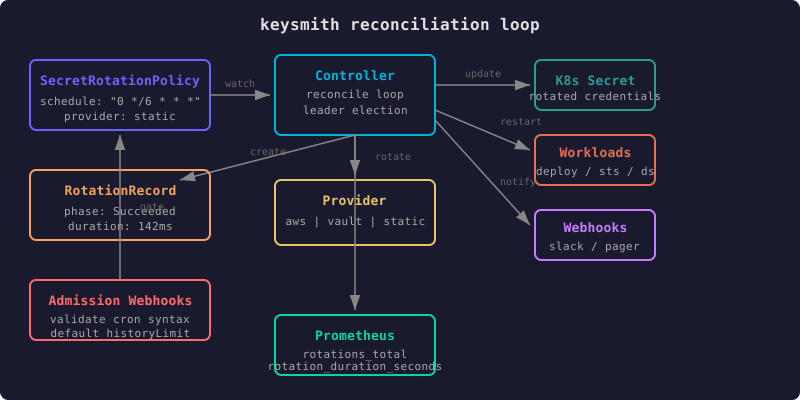
Kubernetes operator that automates secret rotation on a cron schedule. Declare a SecretRotationPolicy CR, and keysmith handles credential generation, secret updates, workload restarts, and audit logging.
What it solves
SOC 2, PCI-DSS, and ISO 27001 all require periodic secret rotation. In practice, teams either rotate manually (error-prone, gets skipped) or build one-off CronJobs (no cluster state awareness, no audit trail, no failure handling). keysmith makes rotation a first-class Kubernetes resource with continuous reconciliation.
How it works
A SecretRotationPolicy CRD defines:
- Schedule: Standard cron expression (5-field + shorthands like
@daily) - Provider: Which backend generates the new credential (AWS Secrets Manager, HashiCorp Vault, built-in
crypto/rand) - Key mappings: How provider keys map to Kubernetes Secret keys
- Restart targets: Deployments, StatefulSets, or DaemonSets to rolling-restart after rotation
- Failure policy:
Fail(mark policy as failed) orIgnore(log and continue)
On each rotation, the controller:
- Creates a
RotationRecordinRunningphase (audit trail starts before the attempt) - Calls the provider to fetch/generate new credentials
- Updates the target Kubernetes Secret
- Patches pod template annotations to trigger rolling restarts
- Finalizes the
RotationRecordasSucceededorFailed - Dispatches HTTP webhooks on
RotationSucceeded,RotationFailed, orRotationSkipped - Prunes old
RotationRecords beyondhistoryLimit
Manual rotation is supported via annotation: set secrets.keysmith.io/rotate=now and the controller rotates immediately. Policies can be suspended and resumed without deletion.
Provider interface
The Provider interface is three methods: Validate, FetchSecret, RotateSecret. Adding a new backend is about 50 lines of Go. Register it in main.go, update the CRD enum, run make manifests.
Built-in providers:
- static: Generates cryptographically random passwords via
crypto/rand(configurable length, 8-256 chars) - mock: Returns deterministic versioned values for testing and demos
- aws: AWS Secrets Manager (stub, SDK integration documented inline)
- vault: HashiCorp Vault KV v2 (stub, client integration documented inline)
Audit trail
RotationRecord is the compliance-critical piece. Every rotation attempt (success or failure) creates an immutable record capturing:
- Trigger source (scheduled vs. manual)
- Start time, completion time, duration
- Provider used
- Keys rotated
- Workloads restarted
- Error message on failure
- Retry count
Records are linked to policies via owner references and auto-pruned per historyLimit. Auditors can query the full rotation history for any secret.
Admission webhooks
Defaulting and validation webhooks run at the API server:
- Defaulting: Sets
historyLimit=10andfailurePolicy=Failif unset - Validation: Parses cron expressions semantically (catches
60 * * * *), requiressecretRef.nameand at least one key mapping
This catches configuration errors at apply time instead of at rotation time.
Observability
Four Prometheus metrics:
| Metric | Type | Purpose |
|---|---|---|
keysmith_rotations_total |
Counter | Total rotation attempts by policy, provider, result |
keysmith_rotation_duration_seconds |
Histogram | Rotation execution latency |
keysmith_next_rotation_timestamp_seconds |
Gauge | Next scheduled rotation (alert on stale policies) |
keysmith_active_policies_total |
Gauge | Count of non-suspended policies |
OpenTelemetry tracing and structured logging via Zap round out the observability stack.
Why an operator, not a CronJob
A CronJob runs a script and exits. It has no cluster state awareness, no status conditions, no leader election, no event reactivity. If a CronJob fails, you find out from missing logs. If a keysmith rotation fails, you get a Failed phase on the policy, a RotationRecord with the error, a webhook notification, and a Prometheus metric increment.
The operator pattern uses continuous reconciliation: if something drifts, the controller corrects it on the next loop. Leader election via Kubernetes Lease objects ensures only one replica runs rotations at a time.
Testing
Ginkgo v2 + envtest (real kube-apiserver + etcd in-process). Tests cover:
- Scheduled and manual rotation happy paths
- Suspended policies
- Provider failure with both
FailandIgnorepolicies - History pruning
- Missing restart targets (graceful degradation)
Coverage: 56%+ controller, 87-100% providers, 91% scheduler.