Rust-ServiceMesh: High-Performance L7 Proxy
Service mesh data plane with circuit breakers, rate limiting, and gRPC support. Built on Tokio, Hyper, and Tower.
What It Does
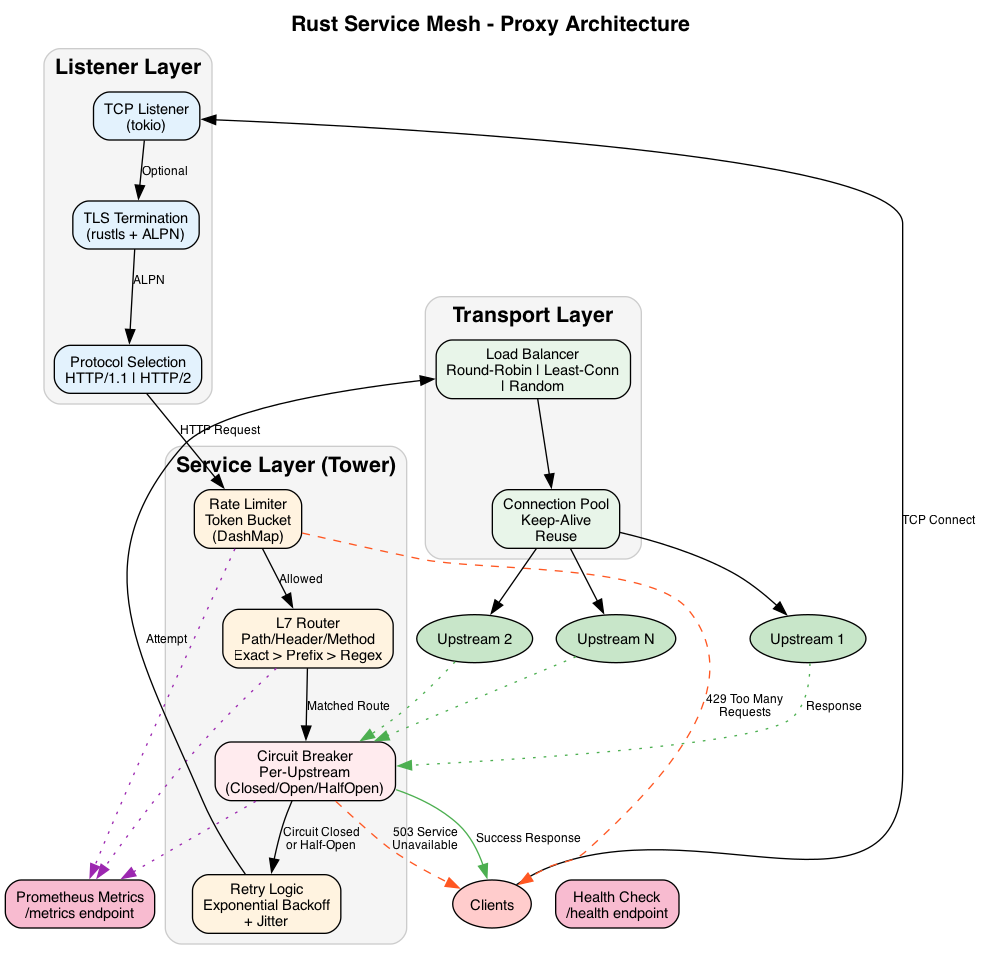
A service mesh proxy sits between your services, handling cross-cutting concerns: retries, timeouts, circuit breaking, load balancing, observability. Instead of implementing this in every service, you deploy a proxy sidecar that handles it transparently.
This project is the data plane—the proxy itself. It handles HTTP/1.1, HTTP/2, and gRPC traffic with sub-millisecond overhead.
This seemed like a no-brainer to imrpove my grasp on Networking.
Request Flow
- TLS termination: ALPN negotiates HTTP/1.1 or HTTP/2
- Rate limiting: Token bucket check per client IP
- Routing: Match request to upstream based on path/headers
- Circuit breaker: Check upstream health, fail fast if open
- Load balancing: Select backend (round-robin, least-conn, random)
- Upstream connection: Forward request, stream response back
Each step is a Tower middleware layer. Layers compose cleanly—add or remove functionality without touching other code.
Circuit Breaker
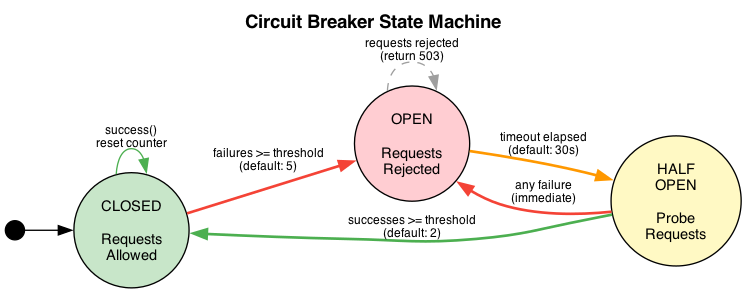
The circuit breaker prevents cascade failures. When an upstream starts failing, stop sending it traffic.
Three states:
- Closed: Normal operation. Track failure rate.
- Open: Too many failures. Reject requests immediately with 503.
- Half-Open: After timeout, allow probe requests. Success closes the circuit, failure reopens.
Each upstream has its own circuit breaker. One failing backend doesn’t affect healthy ones.
Configuration: failure threshold (5 failures), success threshold (2 successes), timeout (30s). All tunable per-route.
Lock-Free Design
The proxy handles thousands of concurrent connections. Traditional locking creates contention.
DashMap for routing tables: Concurrent hashmap with fine-grained locking. Reads don’t block each other.
Atomics for circuit breakers: State machine transitions use compare-and-swap. No locks, no contention.
Arc for shared config: Read-heavy, write-rare data uses atomic reference counting. Config updates swap the Arc pointer.
Result: 52M ops/sec on the circuit breaker path. Locking would cap around 5M.
Challenges & Lessons
HTTP/2 multiplexing was complex. Multiple requests share one connection. Backpressure, flow control, and stream prioritization all needed handling. Hyper does the heavy lifting but configuration matters.
Tower’s service trait took time to internalize. Everything is Service<Request, Response=Response, Error=Error>. Once it clicks, composition is powerful. Before it clicks, the type errors are cryptic.
Testing concurrent behavior required property-based testing. Random request sequences, random failures, assert invariants hold. Found several edge cases unit tests missed.
Performance
| Component | Throughput |
|---|---|
| Circuit breaker | 52M ops/sec |
| Rate limiter | 20M ops/sec |
| Router (exact) | 30M ops/sec |
What I’d Do Differently
The configuration system is basic. YAML files work but hot reloading would help. An xDS-compatible control plane interface would enable integration with Istio/Envoy ecosystems.
I’d add distributed tracing from the start. Propagating trace headers and emitting spans to Jaeger/Zipkin is table stakes for production debugging.